Do I Really Need to Keep That Receipt?
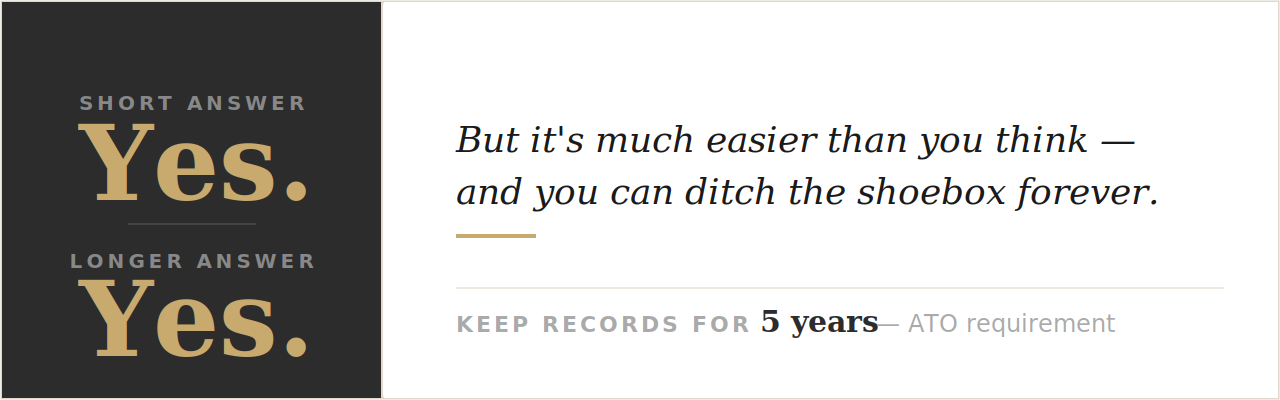
You've just paid for lunch with a client. The waiter hands you a paper receipt. You look at it. You think: Do I actually need this? Will anyone ever check? What if I just... don't?
I hear this all the time. And I get it — receipts are fiddly little scraps that fade, disappear into the bottom of bags, or somehow end up in the washing machine. But when it comes to the ATO, ignoring them is a gamble you really don't want to take.
Let's clear this up once and for all.
What the ATO actually says
The ATO's position is pretty clear: if you're claiming a deduction, you need evidence. That means a receipt, invoice, or similar document that shows the amount, date, supplier, and what was purchased.
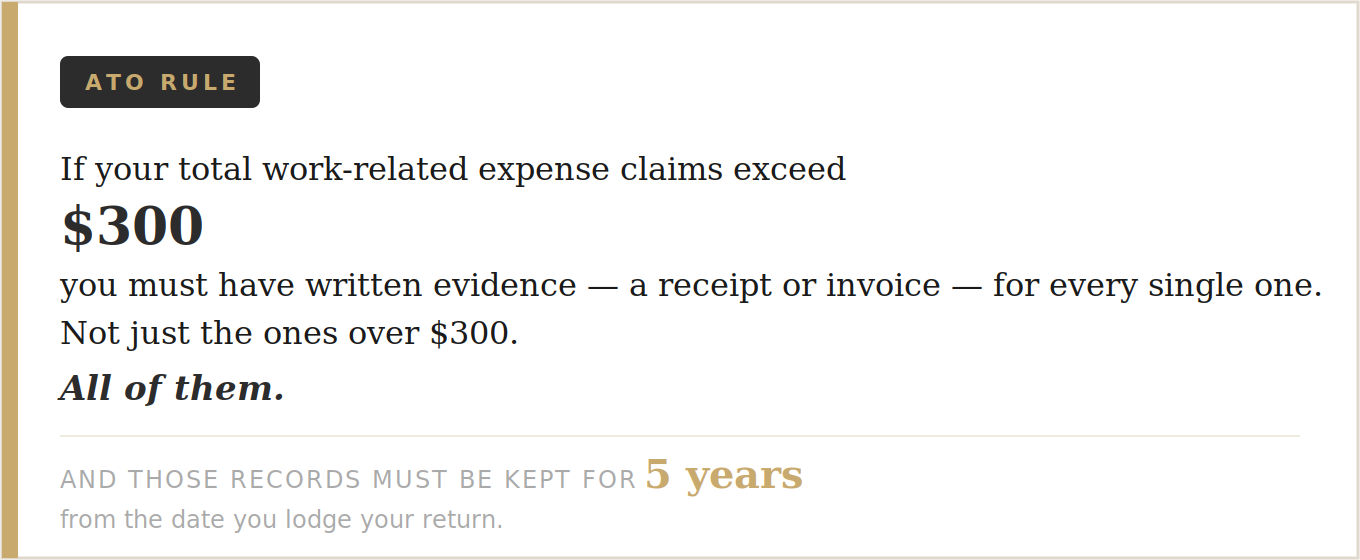
There's a common myth doing the rounds that you can automatically claim $300 without receipts. Not quite. You don't need formal receipts for claims under $300 in total, but you do still need to show how you calculated the amount. A bank statement on its own generally isn't enough.
What goes on a compliant receipt? At minimum: the date, the supplier's name (and ABN for purchases over $82.50), a description of what was purchased, and the total including GST.
But I paid by card — isn't that enough?
Bank and credit card statements help, but they're not a substitute for a receipt. They show the vendor and amount, but not what you actually bought. For GST claims especially, you need the receipt to prove the GST component — your bank statement won't show that.
If you've lost receipts, don't panic — the ATO does allow reconstructed records using bank statements and other evidence. But reconstructed records attract more scrutiny in an audit, and you may not be able to claim the full deduction. Better to keep the receipt in the first place.
And the good news: paper is optional
Here's the part most business owners don't realise. The ATO accepts electronic records exactly the same as paper ones. Photos, scans, PDFs — they're all fine, as long as they're a true and clear copy of the original.
That means you can snap a photo of a receipt the moment you get it, and the paper original can go in the bin. No shoebox. No pile on your desk. No faded thermal paper that's completely unreadable by June.
How to capture receipts and send them straight to Xero
This is where things get genuinely easy. Xero has built-in tools — and integrates with several others — that let you capture a receipt and have it reconciled almost automatically. Here's how:
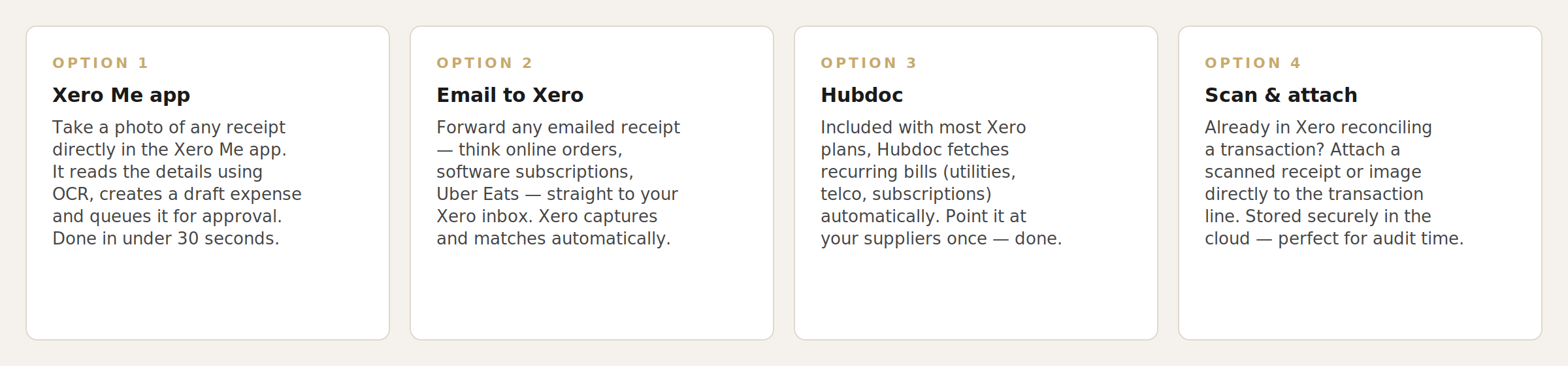
The result is a digital paper trail that lives in your accounts, not scattered across your desk, glove box, and the bottom of your handbag. When BAS time or tax time rolls around, everything is already there. Your bookkeeper (hi 👋) can reconcile without chasing you for missing documents.

Five years. Not five months.
This surprises people. The general rule is you must keep records for five years from the date you lodge your tax return. For assets with depreciation claims, it can be even longer. This is why cloud storage is so much better than a physical filing system — your Xero subscription keeps your records organised and accessible for as long as you need them.
The bottom line
Yes, you need to keep that receipt. But "keeping it" doesn't mean what it used to. A quick photo, a forwarded email, or a tap in Xero Me — and it's done, filed, reconciled, and ATO-ready.
If you're still drowning in paper, or your receipts live in three different places and none of them are Xero, that's something I can help you fix. Getting a clean system in place takes less than an hour — and it saves a lot of pain down the line.
Sources: ATO — Records You Need to Keep · ATO — How Do You Store Your Record Collection? · ATO — Documents to Support and Verify Your Claims